Before this summer, I didn’t know anything about Kyrgyzstan, including how to spell it. Still, when my church offered the opportunity to go this unfamiliar country for a missions trip, I just couldn’t pass it up. So, this past summer from June 29 — July 14, I and nine other members from my church traveled to Kyrgyzstan, where we ran a Christian English camp for children in the Chuy Region with the help of six Kyrgyz/Russian translators.
Despite Kyrgyzstan being a predominantly Muslim country, our team clearly saw God’s presence there. Whether it was through the children’s joy, successful altar calls, or loving local people, we were so encouraged by how much God was working in the area. But perhaps the most obvious sign of God was when He physically revealed Himself to us. I’m reminded of a particular instance near the end of our missions trip where God seemingly took the form of a shepherd and his herd of sheep.
On one of our last evenings in Kyrgyzstan, our team decided to venture into the neighboring countryside. As we made our way across the grassy plain, stepping over random depressions in the ground and piles of animal poop (some more recent than others), we marveled at the surrounding views. Ahead, steep foothills connected to larger snow-capped mountains. To our right and left, more foothills and grasslands converged into the distance. Behind us, the setting sun cast an orange glow over the extensive flatland, including the school we were staying at, which appeared as just a tiny white speck in the middle of some isolated trees.
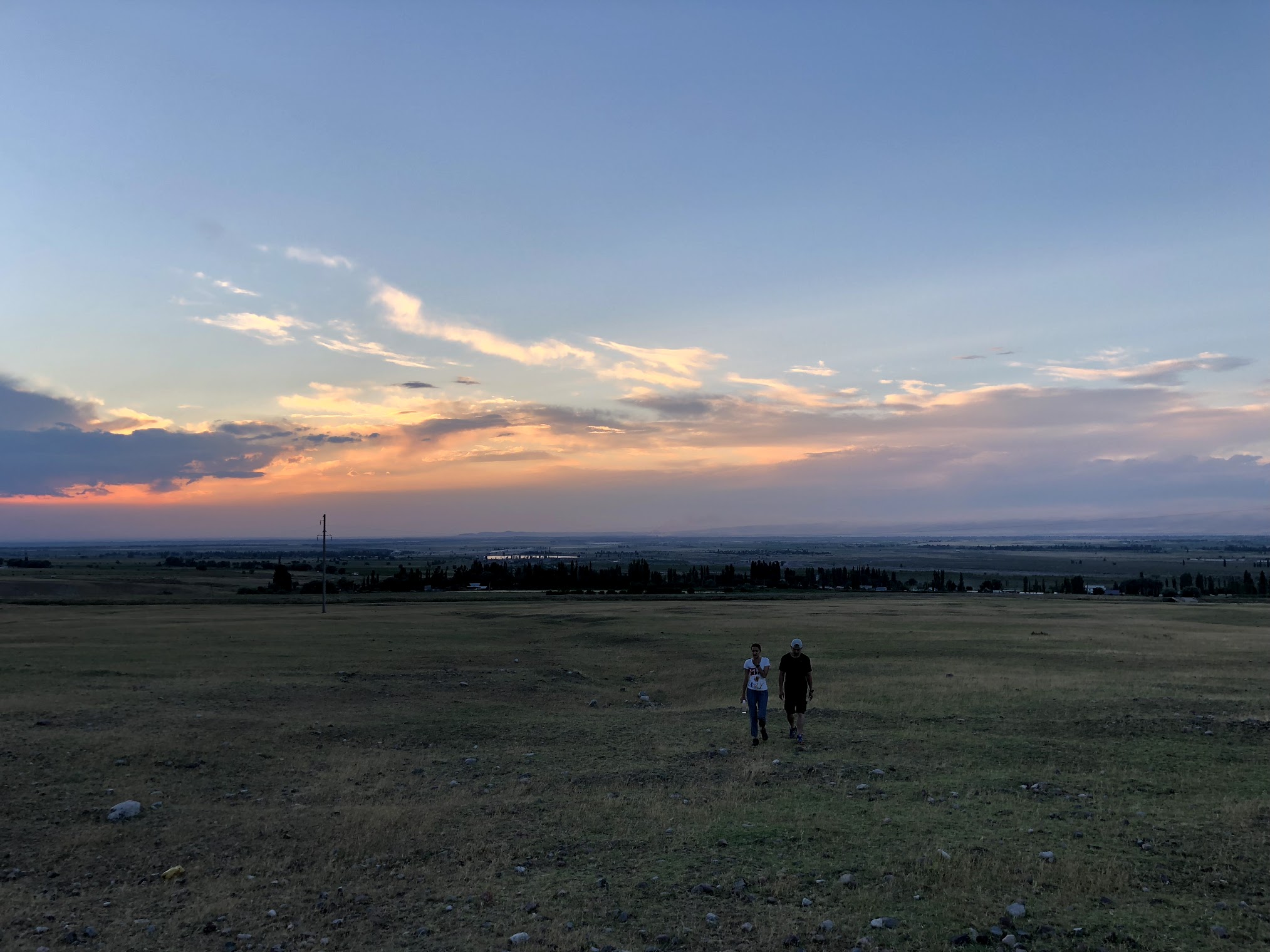
This was the view behind us as we were walking to the mountains. The two people shown are Paul, our church team leader, and Julia, the translator team leader.
Once our team got to the base of the foothills, we, of course, as typical Americans in a foreign country, began to take pictures. But while we were busy chatting and looking at the beautiful scenery to our backs, we failed to notice what was happening in front of us. Two of our members, one from the U.S. and one of our translators, had begun to climb the foothill. Because of the steep elevation and mountain wind, they were unable to hear the rest of our team’s voices calling for them to come back down, and the two quickly reached the top.
While our group continued to yell, we suddenly heard an unknown man’s voice also shouting to our right. Turning our heads, we saw a Kyrgyz shepherd and a stray sheep descending from a neighboring foothill. We had passed by a herd of sheep about a half-mile away, and it seemed like this one sheep had abandoned the main group to run up the side of the foothills.
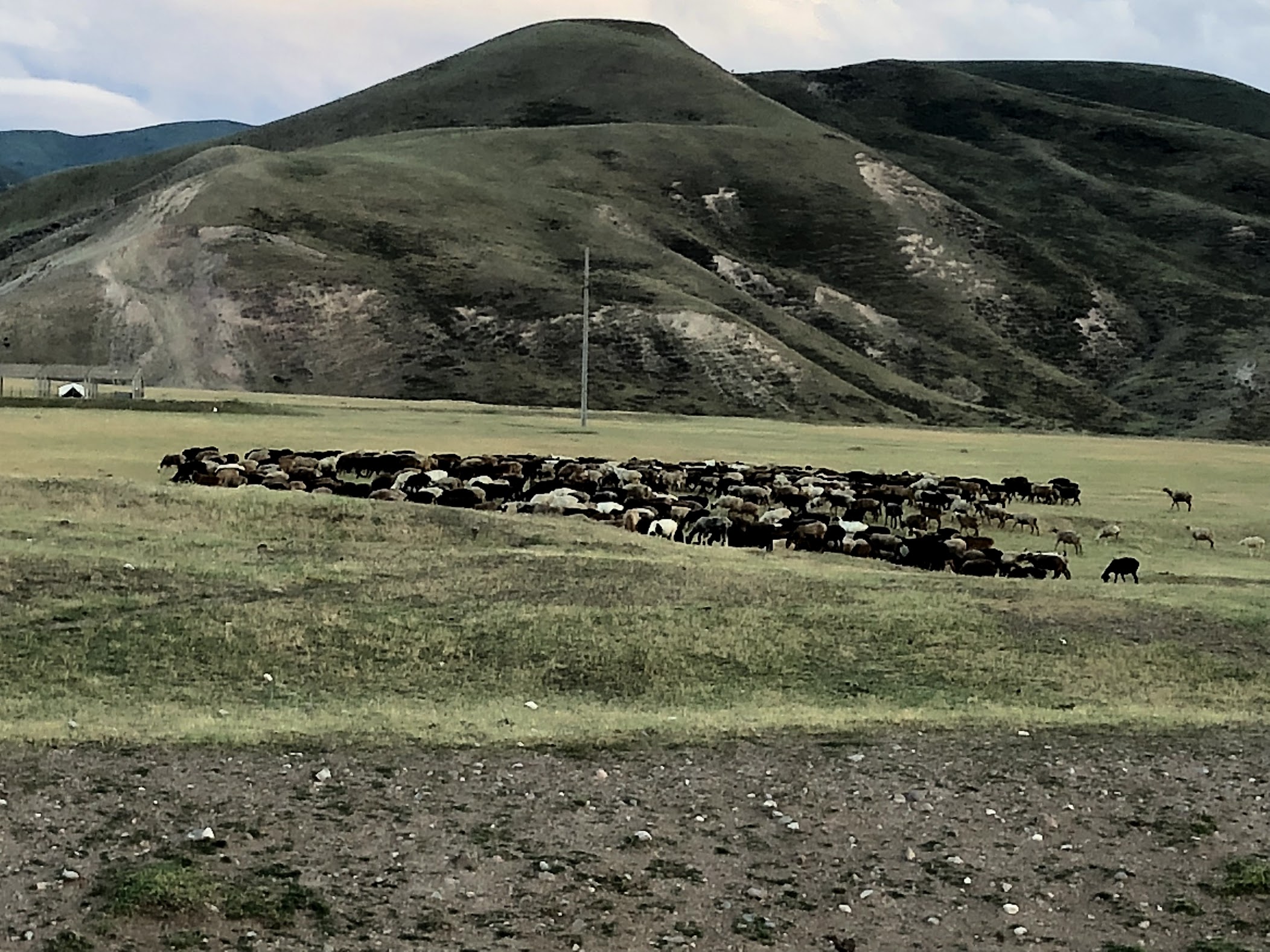
This was the herd of sheep that we saw gathered in front of the foothills. On the left side of the picture, the herd’s pen is also visible.
Seeing this, our team was awestruck. There are countless references to shepherds and their sheep in the Bible, and this sight appeared to be God incarnate. Furthermore, our situations seemed to parallel one another. In each case, a “shepherd” was trying to recover a lost “sheep” who had deserted the herd. Both groups were afraid that the “sheep” would get hurt or go too far, so they refused to stop searching until it was found and brought back home.
To me, this was more than just a coincidence; it was a real glimpse of God’s love.
Jesus tells us a parable about lost sheep in Luke 15:4–7:
Suppose one of you has a hundred sheep and loses one of them. Doesn’t he leave the ninety-nine in the open country and go after the lost sheep until he finds it? And when he finds it, he joyfully puts it on his shoulders and goes home. Then he calls his friends and neighbors together and says, “Rejoice with me; I have found my lost sheep.” I tell you that in the same way there will be more rejoicing in heaven over one sinner who repents than over ninety-nine righteous persons who do not need to repent.
Here, we humans are the straying sheep, and God is our shepherd. In wanting to forge our own paths and pursue our greedy agendas, we left the safety God had already promised us. We sought sin rather than sanctity, leading us to depart from the warmth of God’s overwhelming compassion. Now, as we aimlessly wander in this dark world, we’re vulnerable to all its dangers.
But God never hated us for abandoning Him. After Adam and Eve ate from the tree of the knowledge of good and evil, God searched for them in their hiding. Although He disciplined them, God promised forgiveness by sending His only son, Jesus Christ, to redeem all of mankind so that we humans may join His embrace once again.
In light of this parable about the lost sheep, I’m reminded of the chorus of the song Reckless Love by Cory Asbury, which says:
Oh, the overwhelming, never-ending, reckless love of God
Oh, it chases me down, fights ’til I’m found, leaves the ninety-nine
I couldn’t earn it, and I don’t deserve it, still, You give Yourself away
Oh, the overwhelming, never-ending, reckless love of God, yeah
Albeit controversial, the shepherd’s (and God’s) love could be viewed as “reckless.” With no regard for his own well-being, the shepherd in the parable went out into the wilderness to recover his lost sheep. He left behind the ninety-nine, who were protected by each other, to pursue the one, who deserted the main group and was now defenseless. Having found his sheep, the shepherd carried it home on his shoulders and rejoiced with his friends because he had regained something important which he had lost.
In this same way, God loves us and wants to bring us back to His herd. When Jesus bore the weight of our sins on the cross, He gave us a chance to play our faith in Him. Luke 19:10 says: “For the Son of Man came to seek and to save the lost.” By mercy we are spared from the consequences of our wickedness; by grace we are forgiven and permitted to return to the herd. When we finally accept God’s offer, we are able to join in His celebration as part of the one hundred and live within the sanctuary He created.
Going forward, let us strive to emulate God’s compassion. Even if it requires climbing a mountain in Kyrgyzstan, we need to be the shepherds that find and return the lost sheep in our communities. If we ourselves are the lost sheep, let us cry out for God’s forgiveness and allow Him to carry us back to the herd. In reclaiming just one sheep out of the one hundred, God calls upon the entire kingdom of heaven to rejoice with him as if He has recovered something infinitely precious.